Gender Equality Diversity and Inclusion (GEDI) | November 4, 2026
Care at The Heart of Organizing the Masses
Bolby Nasution
There is a subtle yet powerful distinction in how feminist movements organize and sustain themselves. From the Argentine’s mothers of Plaza de Mayo in the 1970s to the mothers in Indonesia’s 1998 reformation movements, feminist movements have long used an unorthodox means of resistance: the politics of care.
Reiterating the Care Manifesto by the Care Collective, “care is our individual and common ability to provide political, social, material, and emotional conditions that allow the vast majority of people and living creatures on this vast planet to thrive”.
Care work is commonly associated only with gestures of domestic work, when actually, beyond that, it also encompasses acts of mass organizing.
However, care within movements is often overlooked in activism. Activists within social movements often internalize, inherit, and sometimes reproduce masculine notions in the way we organize our movements. Martyrdom is glorified, exhaustion is normalized, and constant availability, despite individuals’ mental capacity have become an absolute precondition of being a ‘good’ activist.
This toxic masculine trait also manifests in the devaluation of care within the movements, especially in the case of individuals’ wellbeing. Care is seen as non-productive, an obstacle, and a weakness. For many, prioritizing personal wellbeing is considered as an act of betrayal to the movements and to the people.
In recent feminist and women-led movements, this masculine notion is continuously challenged. Care resistance persists both in the practices of sustaining the movements and also as a ‘weapon’ in the nonviolent action methods employed in feminist resistance.
Care as the method of nonviolent resistance
Feminist movements use their distinct, marginalized, and often undermined identity as a basis of nonviolent action’s tactics against injustice. As a method of nonviolent resistance, care manifests in the way feminist movements connected how everyday politics affect the masses on structural level
During Argentina’s dictatorship in the 1970s, the Mothers of Plaza de Mayo (Las Madres) led a peaceful resistance movement against the military dictatorship regime. Using their identity as housewives and mothers (often associated with or considered an apolitical and powerless group), they marched in Plaza de Mayo, the heart of Buenos Aires, to demand the truth about their missing children—the victims of forced disappearances. At first, their actions were only considered as ‘mothers who were concerned for their children’, deemed as mere caregivers who practices their day-to-day mundane care tasks. This identity was seen as non-threatening. This tactic worked. Amid the increasingly dangerous and violent retaliation against democracy, their action sparked a massive anti-junta protest involving other movements such as the labor union.
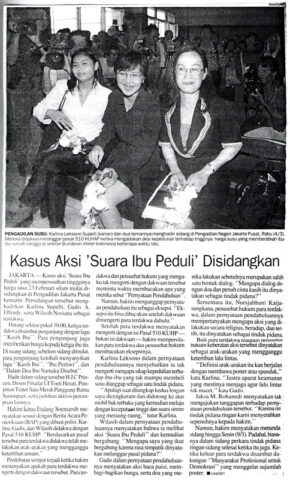
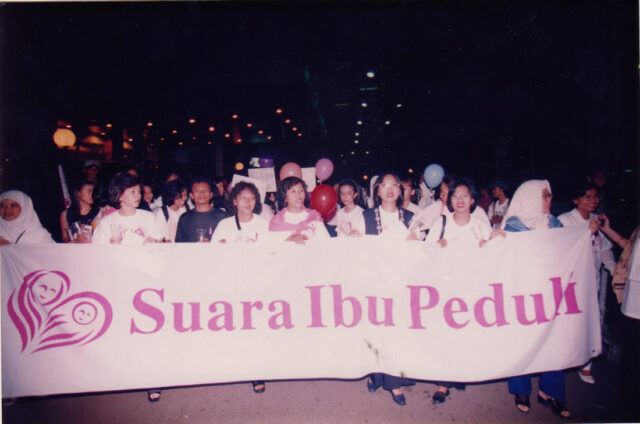
In 1998, in Jakarta, Indonesia, a collective of women called Suara Ibu Peduli, consisted of mothers and homemakers, organized to resist the oppressive New Order regime, an anti-democratic period. As part of the democratic movement, women framed their concerns as a collective effort to address rising formula milk prices, an often-overlooked issue as it was deemed as too domestic, too private, and therefore falls under the responsibility of women. However, this everyday politics framing highlighted the country’s crumbling economy due to oppressive and centralized power of the government.
Similar method and framing are recently employed by a group of women, Ibu Berisik, whose tagline is ‘parenting is political’, effectively showcases how ‘personal’ and ‘domestic’ affairs are intertwined with the big ‘P’ in politics. This movement often brings pans, spatulas, and other utensils commonly found in the kitchen, marching to resist the controversial national free meals program.
Facing violent retaliation, the women in those two countries stood arm-in-arm to resist repressive government, wearing the badge of care as their weapon.
This is what care means as a method of resistance.
Care as the staple of movement’s sustainability
In ensuring the sustainability, accessibility, and preservation of movements in Indonesia, feminist movements have recognized care as an integral part of their organizing work. Women’s March and Aliansi Perempuan Indonesia, for instance, constantly ensure their movements to be inclusive, by including gender and sexual diverse community issues or even providing sign language interpreter during their protests.
In Dayakita, a collective care fund initiative by Humanis Foundation, feminist resourcing mechanisms as a form of care have been implemented over the past year. To nurture movements in their respective regions, Dayakita’s partners have implemented several collective care initiatives.
In North Sumatra, Perempuan Hari Ini attempts to track down, map, and document the unseen history of women and gender diverse individuals in Medan city, North Sumatra. This archiving initiative helps ensure no feminist resistance is left out of the movement’s picture. But for Perempuan Hari Ini, the lasting impact of this initiative lies not only in its outputs but in the process that prioritizes connections and relationships of the people.
Care grows in the process of mutual healing, or the embodiment of ‘sisterhood’ as they track feminist leaders across the province, where they connect with many Women Human Rights Defenders (WHRDs) across different organizations. What’s carved deeply in their heart is how they can have the space to gather, reflect, and rest, where conversations are personal and intimate instead of only about movements strategy, legal analysis, or future movements consolidation.
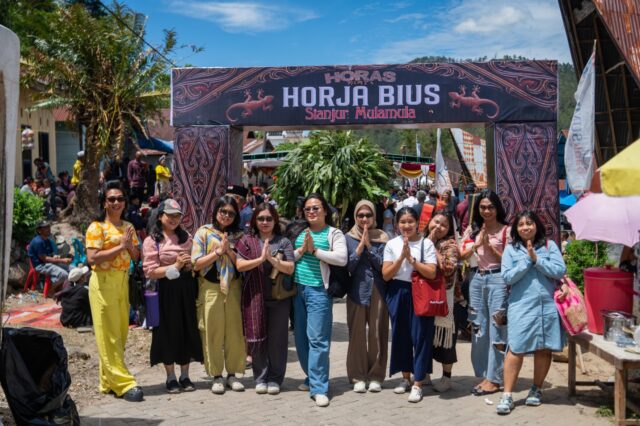
Gamacca, mitra lain Dayakita, menggunakan turnamen olahraga untuk menjangkau komunitas di luar jaringan yang selama ini tak terpapar dengan isu hak asasi manusia. Dalam turnamen olahraga ini, ruang aman dibangun dan proses saling belajar tentang identitas dan keberagaman tidak hanya menjadi pengetahuan yang dimiliki segelintir orang saja. Turnamen ini bukan sekadar perlombaan, tetapi juga ruang untuk menumbuhkan rasa aman dalam kebersamaan.
Gamacca, our other partner, holds sports tournaments to reach diverse communities who are rarely exposed to human rights issues. These tournaments grow to become a safe space of mutual learning about diversity and identity, effectively making the knowledge more accessible. The tournaments are not only a matter of competition, but it is a spce of joy and safety where peer-to-peer support can grow amid the current political climate in Indonesia.
These are just two examples of Dayakita’s 24 collective care initiatives, aimed at strengthening local organizations and, hopefully, sustaining feminist and women-led movements across Indonesia.
This article is not to say that the care tactics employed by feminist movements are a panacea for all the problem within social movements. Nor does it say that Indonesia’s feminist movement has fully embodied the principle of care itself.
But this article recognizes that feminist movement is the pioneer of care, both as a key staple for sustaining movements and as a method of resistance itself. These examples show how care practices grow and persists in feminist movements. Where the prioritize lay in the wellbeing of the individuals within, where meaningful relationship has a place to grow. Inevitably, care is an alternative and ongoing effort to dismantle the masculine organizing methods, to replace the notions that individuals are left to tend to themselves by integrating a specific experience by women in their sisterhood at the heart of our movements.
After all, if we nurture our will to always learn and unlearn that we can achieve a society that upholds dignity and justice for all.