
Civic Rights in A Digital Age (CRIDA) | July 29, 2026
Respect Strength, Question Power: A Note from DRAPAC 2026
Nisrina Nadhifah Rahman
“To respect strength, never power” is one of my favorite quotes from the acclaimed writer and activist, Arundhati Roy. During my involvement in DRAPAC 20261, this quote lingers on my mind, not because it provides an answer, but because it poses a question. What is the difference between strength and power? Where exactly does that difference lie? And how have these two forces shaped the course of human his(her)story and, ultimately, our understanding of humanity itself?
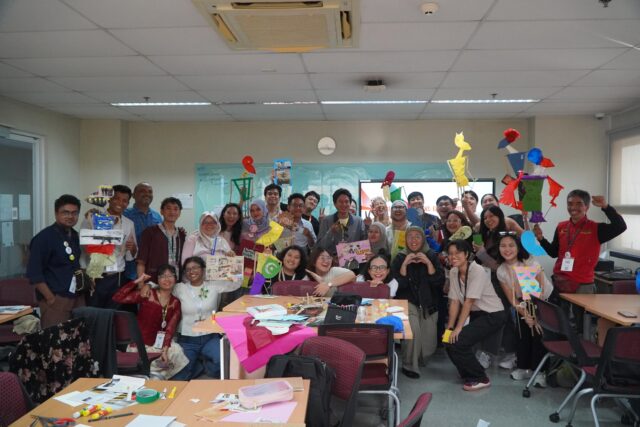
My participation in DRAPAC, however, did not begin solely when I arrived in Manila in June. It was preceded by months of engagement with civil society actors through a series of workshops held across different regions in Indonesia during the first half of 2026. Among these experiences, one that remains particularly vivid in my memory is a workshop in East Lombok, particularly during a session on collective care.
During the workshop, we map out care practices in movements at different levels: individually, within their communities, across coalitions, and in broader social contexts.
One group responded with a local East Lombok expression: “Na Pada Ajong Ta,” which conveys the idea of moving in harmony with one another, walking side by side, keeping pace together, and sharing a common rhythm.
I was instantly struck by the phrase.
Amid the noise and complexity of the world we live in, the language of authority often urges us toward uniformity. We are repeatedly told to “unite,” as though unity requires everyone to move in the same direction, at the same pace, and with the same voice. Yet perhaps what we need is not unity in its most rigid sense, but something closer to “Na Pada Ajong Ta,” moving in harmony with one another, walking side by side, and keeping pace together without erasing our differences.
I found myself returning to Arundhati Roy’s words: “To respect strength, never power.” Maybe “strength” is something inherently plural, contextual, and deeply human. It emerges from our unique experiences, relationships, and communities. While “power”, on the other hand, can be so intoxicating, often seeks standardization. Power gravitates toward control, conformity, and the illusion that everyone can, or should, move as one. And this type of ‘power’ that controls, drips all over modern technologies.
AI (just like any other technology) is never neutral.
Throughout DRAPAC, countless sessions explored different dimensions of Artificial Intelligence (AI). The sessions that captivated me most were those that treated AI not merely as a technological development, but as a political one.
One recurring insight was that AI outputs are shaped by far more than the prompts entered by users. They are also influenced by invisible system prompts, training datasets, institutional priorities, commercial interests, and political decisions embedded within the technology itself.
In other words, AI does not simply generate answers. It reflects the values, assumptions, and power relations that have been built into it.
And none of this comes without cost.
Equally important are the costs associated with what AI systems fail to capture, represent, or include in their outputs. These omissions are far from neutral. They can result in the marginalization and exclusion of certain communities, perspectives, languages, and forms of knowledge that do not fit neatly within dominant datasets or technological priorities.
There is also another, more subtle cost: the growing fear of making mistakes.
As AI becomes increasingly embedded in our everyday lives, it often presents itself as a promise of efficiency, optimization, and even perfection. In many ways, our growing dependence on AI reflects a deeper attachment to the idea that there are always a correct answer and a perfect formulation. Yet this pursuit of perfection is not politically innocent. It echoes older legacies of coloniality that privilege order and standardization while leaving little room for experimentation and human imperfection.
One of the most well-known principles in computer programming, particularly in the context of Large Language Models (LLMs), is the phrase “Garbage In, Garbage Out” (GIGO). At its simplest, the principle suggests that the quality of an output depends on the quality of the input.
But after the discussions at DRAPAC, I have come to see GIGO as more than a technical principle. It is also a political one. “Garbage In, Garbage Out” is ultimately a question of power. The quality of AI outputs is shaped not only by data, but also by the social, political, and economic structures that determine whose knowledge is collected, whose experiences are prioritized, and whose realities are rendered invisible.
Driven by economic interest, Big Tech actively trains AI to increase dependency on technology, especially algorithms.
In 2022, writer and scholar Alfie Bown introduced the concept of “desirevolution” in his book “Dream Lovers: The Gamification of Relationships”. The term describes a condition in which human desires, from politics, beverages, games, and travel destinations to humor and romantic relationships are increasingly shaped and directed to suit certain economic and political agendas, At DRAPAC, particularly during the Algorithm Anonymous session, we explored how digital platforms are designed not only to capture attention but also to shape habits, desires, and emotional attachments. This closely resonates with what Bown describes as a “Libidinal Economy”, the ways in which contemporary digital capitalism, algorithms, and Big Tech actively shape, channel, and exploit human desire.
There are apparent patterns in the way contemporary technology works: it validates to encourage continuous engagement; it designs tricks to influence users into making purchases, sharing more data, or signing up for services that they never really need.
Circling back to the beginning of this writing, inspired by Arundhati Roy’s reminder to “respect strength, never power,” I returned from DRAPAC feeling that perhaps even that is not enough.
Because strength, much like power, also has layers that need to be continuously examined, interrogated, and questioned. While doing so, we must also continue re-examining our own roles and positionalities and reflect on where we stand in relation to the systems and structures around us. Let’s not stop questioning power, but to remain curious about the many forms it takes, including those we may carry ourselves.