Climate Justice | June 2, 2026
How NURTURE Transforms Local Food Systems, One Local Entrepreneur at A Time
Namira Fathya & Selma Theofany
West Manggarai grows quietly. Candlenut trees on the dry eastern hills, coffee in the highlands of Deru, and in backyards and along farm edges. For generations, these plants fed families, healed skin, and kept communities going. Today, for a new generation of entrepreneurs in West Manggarai, those same plants are becoming the foundation for local businesses.
In West Manggarai, more than 200 participants registered for NURTURE, a business assistance program by one of Urban Futures’ partners, Prestasi Junior Indonesia (PJI). 78 were selected for the Youth Entrepreneurship Camp, 47 receiving intensive business assistance, and 26 successfully completing the program while showing significant business and personal growth. Among them were Rio, founder of Nerra Coffee, and Omik, founder of Nggelok Tara. Their businesses are different, one sells coffee, the other natural personal care products. However, both are built on the same principle: creating added value from local crops through a more integrated ecosystem.
Rio and the Making of Nerra Coffee
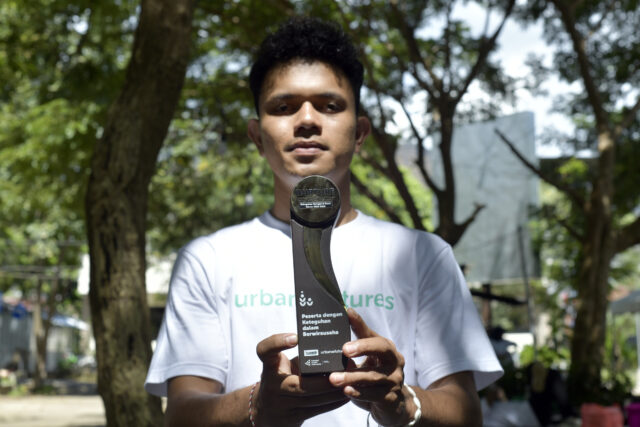
Image 1. Portrait of Rio, Nerra Coffee owner, during Pasar Kreasi Pangan held at the Kampung Ujung parking area.
Gerardus Kutrisman Trionistan, warmly known simply as Rio, launched Nerra Coffee in 2021. His beginnings were modest. At first, he sold instant coffee from a bicycle, the classic kopi keliling Indonesians know and love.
By 2022, that small operation had grown into his own brand: Nerra Coffee. Inspired by the city’s rapid growth, Rio decided to build a business around what he knew best: coffee. The business was deeply personal from the beginning.
“Many of my family members are coffee farmers here in West Manggarai,” he said. “Our coffee is a special robusta. It is bold and bitter. I started buying beans directly from my family, roasting and brewing them manually to really bring out that smoky, bitter taste.”
Rio first crossed paths with his business coach, Rian from PJI, by hanging out together in 2024. Rian later invited Rio to join NURTURE in 2025. Rio recalls, laughing. “He is like a brother to me. He will call me out if I slack off, and he reminds me that a business has to have targets. He inspires us to aim higher.”
“Even though it was difficult, in the end I felt how useful all the training really was. The coaching sessions helped so much in terms of mindset, business and financial management, and time management. It really showed in our overall revenue, which started climbing after I joined NURTURE.”
Rio’s challenge is just a small part of a much larger problem: gentrification. When an area gets pricier, it can displace the residents. Many Indonesians know Labuan Bajo for its pristine beaches, Komodo dragons, and sailing trips. That rapid tourism growth has attracted people from across the Manggarai region, spanning the entire western half of Flores island, in search of opportunity. Rio is one among many local migrants. “The profits from tourism are not shared equally. It is getting harder for us to live here,” Rio said, quietly.
Rio tries to respond to this reality in small but deliberate ways. He keeps Nerra’s products affordable, pricing them between Rp5,000 and Rp25,000, while still maintaining confidence in their quality. “I am keeping my products affordable so my friends can still afford our coffee. However, I am very confident in what we offer,” he said.
Today, he regularly opens up his stall to fellow participants, giving them space to display and sell their products alongside his own.
Beauty Born from the Land: Omik and Nggelok Tara
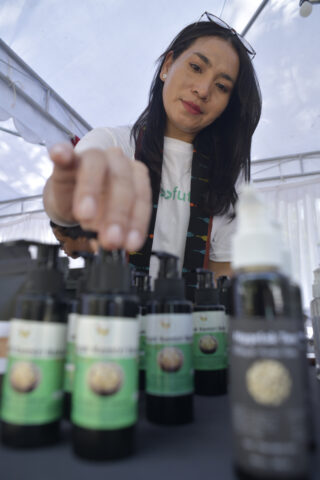
Image 2. Omik, owner of Nggelok Tara, arranges items at the booth during Pasar Kreasi Pangan.
Among NURTURE’s participants, most businesses focused on food and beverages. Nggelok Tara stood out. Founded by Wihelmina Ladung or Omik, the business produces natural personal care products made from local ingredients: candlenut hair oil, moringa face masks, turmeric masks, and coconut oil. She looked closely at practices that already existed within her community and found ways to turn them into sustainable products.
Growing up in Manggarai, Omik was surrounded by homemade beauty remedies. Today, those same remedies ingredients became the basis of her business.
When Omik sources directly from local farmers, she helps to sustain a locally-sourced supply chain. The market agrees. Alongside other products like coconut oil and other face masks, her candlenut oil and moringa masks sell out the fastest, creating opportunity for her resellers who are mostly women.
For Omik, NURTURE became especially important in strengthening the parts of business she found most difficult, financial record-keeping and business administration.The program itself was demanding. Sessions were intentionally held on weekends to avoid conflicting with participants’ regular work schedules, but life still intervened.
At one point, Omik had to pause her participation to care for her sick mother. Still, she chose to continue. “I wanted to prove myself to my parents. At first, I was underestimated because I did not follow my father’s path,” she laughed. Over time, the business began to change not only her income, but also her confidence.
“With a steady brand, I am now so much more assured in my own business, and I have finally been able to prove myself to my father. He is now my biggest fan, always showing off my products to his friends and relatives.”
Pasar Kreasi Pangan: Where It All Came Together
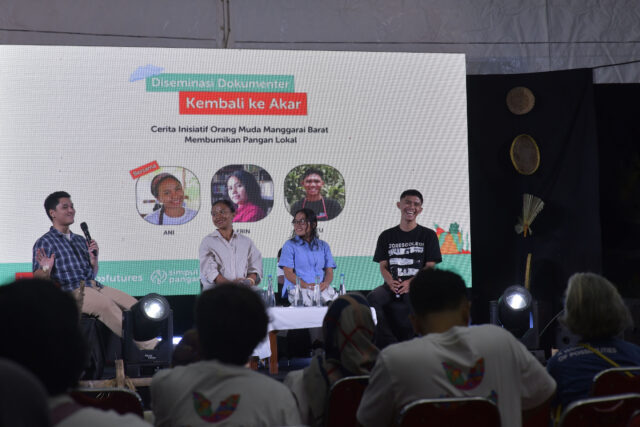
Image 3. Discussion during the dissemination of the documentary ‘Kembali ke Akar’ at the Festival Pasar Kreasi Pangan.
On April 29, 2026, UF Indonesia, in collaboration with the local government of West Manggarai, hosted Pasar Kreasi Pangan, as a year’s worth of work in West Manggarai. One of the event’s highlights was the graduation ceremony for the 26 NURTURE participants who completed the program.
Throughout the venue, booths showcased products created by the youths involved in the UF, each representing a different piece of the local food system.
During the event, the ASLI Consortium presented the commodities from the participatory guaranteed system. WRI Indonesia shared their research and educational module on food waste. Later in the afternoon, participants presented the results of SAPA BUMI, an ideation program implemented by the KOPAJA Consortium. Toward sunset, the Pangan Bernas Consortium hosted a local food tasting session. Later in the evening, the Simpul Pangan Consortium organized a film screening and discussion on archiving local food knowledge.
In true West Manggarai fashion, the event concluded with music and dance performances. More than anything, Pasar Kreasi Pangan felt like a celebration of collective effort, a reflection of what can happen when the youth are given the space to shape the future of their own food systems. It is precisely the kind of spirit that UF aims to foster in the region.